

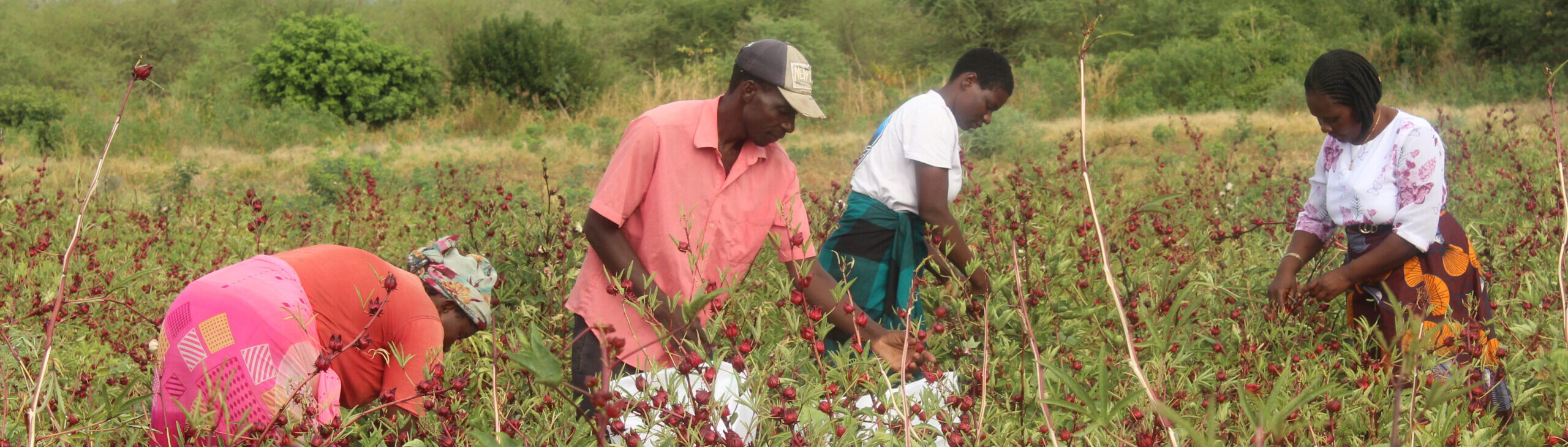
The Organics4Zim project strengthened organic agriculture in Zimbabwe by training smallholder farmers and wild gatherers in organic and fair trade certification, processing and marketing and connecting them to international value chains.
Starting situation
Zimbabwe has been suffering from economic instability, mismanagement and the consequences of climate change for years. Inflation reached over 800% in 2020, and around half of the population is affected by food insecurity. Small farmers in particular are struggling with falling incomes, uncertain markets and high production costs.
At the same time, the agricultural sector – which employs two-thirds of the population – offers great potential, especially due to the growing international demand for organic products. The still young organic farming sector is in the process of being established, but limited knowledge about certification processes, a lack of processing capacities and low market access are slowing down its development.
Against this background, Organics4Zim set out to create sustainable sources of income and strengthen ecological value creation in Zimbabwe through targeted training, certifications and new processing capacities together with the main project partner, the Organic Farming Academy. An innovative pilot approach also tested the conversion of plant residues from baobab production into biochar, which was introduced into the fields as a CO2 reservoir and soil conditioner.
Goal
Support services for environmentally friendly, certified, export-oriented crop production for smallholders/wild collectors are offered in a sustainable way.
RESULTS
- 17 training modules developed for organic certification and wild collection
- 18,011 smallholder farmers (75% of whom are women) trained and certified according to international organic and fair trade standards – with access to premium export markets
- Digital traceability system introduced with SAP and Organic Africa: 20,541 farmers and collectors are registered and connected to the organic market
- Decentralised processing centres with 140 workstations set up – here, among other things, rosella, baobab, stevia and macadamia are processed
- 3 sites with 48 jobs built that transformed 4,000 tons of baobab shells into 1,000 tons of biochar – for CO2 storage, better soil health and additional income through certificate sales
- A virtual platform with learning modules and a separate virtual learning management system for the training center were developed.
Project:
2021 – 2025
Project budget:
€2.93 million
Partner:
Organic Farming Academy
Country:
Zimbabwe
Funder:
BMZ via sequa
OUR PARTNERS